Pembungkusan memainkan peranan penting dalam memastikan keselamatan, kualiti dan jangka hayat produk, terutamanya dalam industri makanan dan farmaseutikal. Pelbagai jenis beg pembungkusan, seperti beg berbentuk bantal, beg rata dan beg penyangga diri, digunakan secara meluas, setiap satu menawarkan kelebihan yang berbeza dari segi kualiti pengedap, estetika dan kesesuaian untuk jenis produk tertentu. Di antara banyak kaedah, pembungkusan vakum menyerlah kerana keupayaannya memanjangkan jangka hayat produk dengan memperlahankan pengoksidaan, menghalang pertumbuhan mikrob dan menjadikan penyimpanan lebih cekap. Mesin pembungkusan vakum, terutamanya jenis ruang tunggal dan dua ruang, adalah penting dalam mengautomasikan proses penyedutan, pengedap dan inflasi, memastikan integriti produk dan meningkatkan kecekapan pembungkusan keseluruhan.
Jenis beg pembungkusan
Beg filem plastik biasa adalah dalam bentuk berikut:
Beg berbentuk bantal. Kaedah jahitan am adalah untuk menindih jahitan membujur dan kemudian mengelak kedua-dua hujung, seperti yang ditunjukkan dalam Rajah (1).
Beg rata. Ia boleh dibahagikan kepada beg tertutup tiga sisi Rajah (2) dan beg tertutup empat segi Rajah (3).
Beg berdiri. Yang biasa ialah beg sudut runcing Rajah (4), beg segi tiga Rajah (5), dan beg lajur padu Rajah (6).
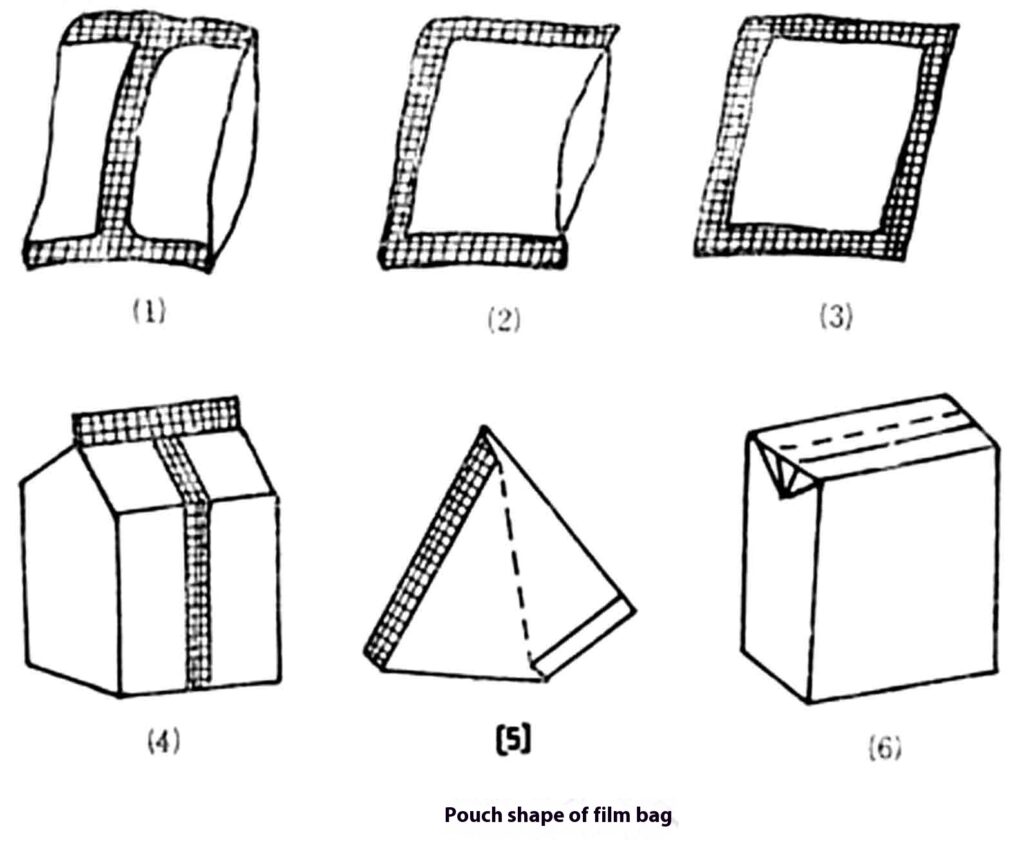
Dalam proses membuat beg, ia biasanya dimeterai secara membujur dahulu dan kemudian secara mendatar. Oleh itu, dalam keseluruhan panjang jahitan pengedap bertindih dan bercantum punggung beg berbentuk bantal, tiga atau empat lapisan filem bertindih pada bahagian pengedap, yang mempunyai kesan tertentu ke atas kualiti pengedap. Bilangan lapisan filem dalam keseluruhan panjang jahitan pengedap beg kedap tiga belah rata adalah sama, dan kualiti pengedap lebih baik, tetapi bentuk beg tidak simetri dan estetikanya lebih buruk sedikit. Pengedap empat sisi mengatasi kelemahan dua situasi di atas, tetapi lebih banyak bahan pembungkusan digunakan, dan ia sering digunakan untuk mesin pengedap mudah untuk pakej kecil. Pelbagai beg sara diri mempunyai penampilan yang cantik dan kelebihan sebagai sara diri, yang sesuai untuk proses pembungkusan seterusnya dan penempatan dan paparan produk. Walau bagaimanapun, mereka mempunyai keperluan yang tinggi untuk bahan pembungkusan dan bahan pembungkusan komposit harus digunakan.
Mesin pembungkusan vakum
Pembungkusan vakum adalah untuk memasukkan makanan ke dalam bekas pembungkusan, mengeluarkan udara di dalam bekas, mencapai tahap vakum tertentu, dan kemudian mengelak dan membungkusnya. Ini adalah kaedah pembungkusan baharu yang telah berkembang pesat dalam industri makanan dan farmaseutikal di dalam dan luar negara sejak beberapa tahun kebelakangan ini. Ia mempunyai ciri-ciri berikut:
(1) Memperlahankan pengoksidaan dan kemerosotan, menghalang pembiakan mikrob, dan dengan itu memanjangkan jangka hayat makanan. Makanan melekat pada sejumlah mikroorganisma tertentu, yang membiak di udara dan menyebabkan makanan rosak. Selepas udara dikeluarkan, mikroorganisma menghalang pembiakan jika tiada oksigen, dan banyak bahan mudah teroksida juga teroksida secara perlahan kerana kekurangan oksigen.
(2) Ia kondusif untuk operasi pensterilan haba. Sekiranya terdapat sejumlah besar udara di dalam bekas yang mengandungi makanan, pengaliran haba adalah lemah, makanan mengambil masa yang lama untuk dipanaskan, dan masa pensterilan dilanjutkan; selepas udara dikeluarkan, makanan cepat naik ke suhu yang diperlukan. Selain itu, mengeluarkan udara juga boleh mengelakkan bekas pecah akibat pengembangan gas semasa proses pemanasan dan pensterilan.
(3) Selepas udara dikeluarkan, volum dikurangkan, yang mudah untuk penyimpanan dan pengangkutan.
(4) Oleh kerana makanan yang dibungkus perlu mengekalkan jumlah kelembapan tertentu dan bahan pembungkusan juga mempunyai tahap kebolehtelapan udara tertentu, pembungkusan vakum tidak dapat mencapai vakum lengkap, dan tahap vakum tertinggi boleh mencapai -0.096~0.099MPa.
Prinsip struktur mesin pembungkusan vakum satu ruang
Rajah menunjukkan struktur dan prinsip kerja mesin pembungkusan vakum bersaiz sederhana, yang digunakan secara meluas dalam kilang pemprosesan makanan kecil dan sederhana.

Proses pembungkusan makanan yang dibungkus adalah: letakkan badan bungkusan di dalam tangki vakum untuk orientasi, letakkan mulut beg pada blok pemanasan, masukkan muncung sedutan vakum ke dalam mulut beg, dan tekan penutup tangki vakum. Selepas itu, suis had dan geganti secara automatik akan mengawal penyedutan, penekanan panas dan pengedap, mematikan penyejukan, pembukaan automatik dan proses lain. Tahap penyedutan, masa, masa pengedap haba, masa penyejukan, dll. hendaklah diuji dan diselaraskan terlebih dahulu.
Proses kerja mesin pembungkus vakum kecil adalah sama seperti mesin pembungkusan vakum kecil, kecuali setiap proses dikawal secara manual.
Kaedah pemanasan untuk pengedap tekanan panas biasanya menggunakan pemanasan nadi. Elemen pemanasannya menggunakan wayar rintangan rendah dan voltan adalah kira-kira 10-50V. Apabila arus yang kuat dihantar, elemen pemanas wayar serta-merta menjana haba dan menghantarnya ke blok pemanasan, dan kemudian mulut beg ditekan panas dan dimeteraikan. Kaedah penyejukan pengedap boleh menjadi penyejukan semula jadi atau peredaran air penyejuk untuk menjadikan mulut beg sejuk dengan cepat untuk mengelakkan filem plastik di kawasan pengedap daripada terlalu panas.
Struktur mesin pembungkusan inflasi vakum dua ruang

Bilik kerja. Ia terdiri daripada penutup atas dan tapak bawah (ruang A dan ruang B). Penutup atas dan pangkal bawah dimeterai dengan gelang getah.
Terdapat dua ruang udara kecil di bahagian atas penutup. Ruang udara kecil dilengkapi dengan mekanisme pemanasan. Tolok vakum dipasang di luar bahagian atas penutup, dan terdapat juga terminal pemanasan elektrik, paip ruang udara kecil, dan paip ekzos ruang udara. Penutup atas dan bawah disambungkan dengan satu set pautan empat bar untuk memastikan putaran lancar.
Mekanisme pemanasan dan pengedap. Kepala pemanas dan penutup disambungkan oleh dua kepingan kuprum di kedua-dua hujungnya. Dua blok kuprum pengikat pada kedua-dua hujung tali pinggang pemanas elektrik diikat dengan skru untuk mengelakkan sentuhan yang lemah. Kepala pemanas elektrik dan penutup pengedap benar-benar terlindung untuk mengelakkan litar pintas.
Semasa operasi, ruang udara kecil dan ruang udara besar dipindahkan pada masa yang sama. Kepala pemanas tidak berfungsi apabila perbezaan tekanan pada kedua-dua hujung adalah sama. Apabila injap udara ruang udara kecil disambungkan ke atmosfera untuk menghasilkan perbezaan tekanan, kepala pemanasan ditekan ke bawah, meterai ditekan dan dipanaskan pada masa yang sama. Masa dan suhu pemanasan boleh dilaraskan. Sistem pemanasan adalah jenis pengatur tekanan, yang boleh digunakan untuk bahan pembungkusan yang berbeza. Tombol pemilihan ditetapkan pada panel kawalan mesin. Tali pinggang pemanasan elektrik ialah tali pinggang aloi. Pemanasan tanpa beban adalah dilarang sama sekali.
Pangkalan. Ia dibahagikan kepada dua ruang, A dan B, dengan 16 muncung inflasi di kedua-dua belah pihak. Terdapat pad pemanas pada kedudukan kepala pemanas yang sepadan, dan kumpulan suis sesondol untuk menukar antara ruang A dan B ditetapkan di bawahnya.
Conclusion
Jenis beg pembungkusan dan mesin pembungkusan vakum adalah penting dalam industri makanan dan farmaseutikal, memastikan kualiti produk dan memanjangkan jangka hayat. Walaupun pelbagai jenis beg tersedia untuk disesuaikan dengan bahan dan estetika yang berbeza, mesin pembungkusan vakum meningkatkan proses pemeliharaan dengan mengeluarkan udara, mencegah pengoksidaan dan memudahkan pensterilan terma. Struktur dan prinsip kerja mesin pembungkusan vakum satu ruang dan dua ruang memainkan peranan penting dalam menyelaraskan proses pembungkusan, menjadikannya lebih cekap, boleh dipercayai dan sesuai untuk pelbagai produk. Memahami kaedah pembungkusan ini adalah penting untuk mengoptimumkan operasi pembungkusan dan memastikan produk dilindungi dengan baik untuk penyimpanan dan pengangkutan.
Do not hesitate toContact us sekarang jika anda mempunyai sebarang soalan.



 English
  Malay
Malay